About Journal
About Journal
The journal covers economics, management, and digital business, with an emphasis on the connections between economic development, organizational strategy, and technological innovation. It welcomes research on entrepreneurship, finance, consumer behavior, digital transformation, and sustainable business practices that advances scholarly knowledge and informs professional practice.
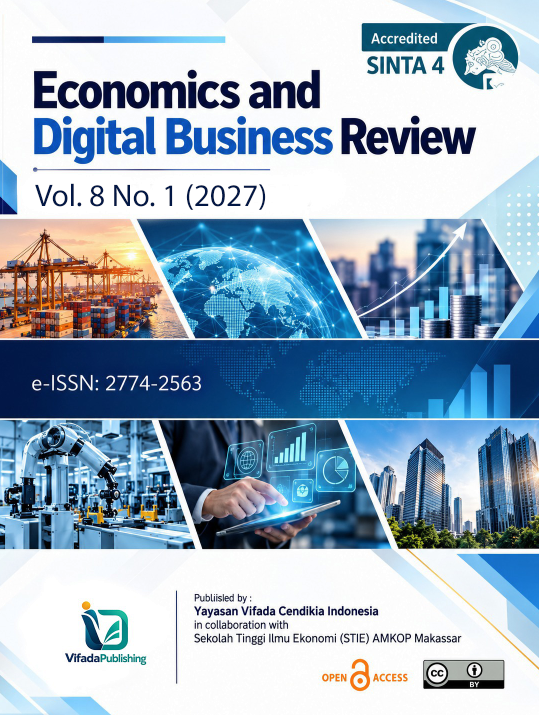
Economics and Digital Business Review (Online ISSN: 2774-2563) is a peer-reviewed, open-access scholarly journal published by Yayasan Vifada Cendikia Indonesia in collaboration with Sekolah Tinggi Ilmu Ekonomi (STIE) AMKOP Makassar, Indonesia.
Established in 2020, Economics and Digital Business Review provides an academic platform for disseminating original scholarship in economics, management, business, entrepreneurship, and the evolving digital economy.
The journal advances scholarly understanding of economic systems, organizational performance, business strategy, financial practices, market development, and technological innovation. It welcomes research examining traditional economic and managerial challenges alongside contemporary developments in digital business models, financial technology, artificial intelligence, digital platforms, entrepreneurship, and technology-enabled organizational transformation.
The journal encourages theoretical, empirical, conceptual, and applied investigations that contribute to academic knowledge and evidence-based professional practice. Research may address private enterprises, public institutions, financial organizations, industries, micro, small, and medium-sized enterprises (MSMEs), startups, and other organizational settings. Particular consideration is given to research demonstrating methodological rigor, theoretical relevance, practical significance, and meaningful implications for economic and business development.
Published twice annually, the journal applies a double-blind peer-review process to support independent scholarly assessment and publication quality. It promotes interdisciplinary research, responsible innovation, sustainable business development, organizational competitiveness, financial resilience, and inclusive economic advancement at national and international levels.
EDITORIAL PROCESS
Double-Blind Peer Review
Independent scholarly evaluation, editorial assessment, and academic quality assurance.
PRIMARY DISCIPLINES
Economics & Business
Management, digital business, finance, entrepreneurship, and innovation.
PUBLICATION FREQUENCY
Biannual
Two issues annually, supporting continuous scholarly development.
RESEARCH AREAS
Focus & Scope
The scholarly scope of Economics and Digital Business Review encompasses foundational and contemporary investigations across economics, management, accounting, finance, entrepreneurship, and digital business. The journal organizes its disciplinary coverage into twelve complementary research areas. These categories represent major areas of interest rather than restrictive boundaries. Interdisciplinary manuscripts are welcome when they demonstrate appropriate theoretical foundations, clearly articulated research problems, sound methodologies, and identifiable contributions to economics or business scholarship.
RESEARCH AREA 01
Economics, Development & Public Policy
Research exploring economic development, institutional structures, policy interventions, resource allocation, market performance, and their implications for national and regional welfare.
RESEARCH AREA 02
Digital Economy & Platform Ecosystems
Studies examining digitally connected markets, technology-enabled transactions, platform competition, online economic participation, and emerging forms of digital value creation.
RESEARCH AREA 03
Digital Business & Strategic Management
Research investigating business strategy, organizational transformation, competitive advantage, innovation capabilities, and the strategic management of digital resources and technologies.
RESEARCH AREA 04
Entrepreneurship, Startups & MSMEs
Scholarly investigations of entrepreneurial activities, startup development, business innovation, entrepreneurial ecosystems, and the resilience and competitiveness of smaller enterprises.
RESEARCH AREA 05
Marketing, Branding & Consumer Behavior
Research on marketing effectiveness, customer decision-making, brand management, market communication, consumer engagement, and evolving patterns of consumption in physical and digital markets.
RESEARCH AREA 06
Finance, Banking & Financial Technology
Research examining financial institutions, corporate financing, investment decisions, financial risks, banking innovation, and emerging technology-enabled financial services.
RESEARCH AREA 07
Accounting, Auditing & Digital Reporting
Research exploring accounting systems, financial reporting, auditing practices, fiscal accountability, information transparency, and technological innovation in accounting and assurance.
RESEARCH AREA 08
Artificial Intelligence & Business Analytics
Studies investigating the application, adoption, governance, and organizational implications of analytical technologies, artificial intelligence, and data-driven decision-making.
RESEARCH AREA 09
Human Resource Management & Organizations
Research examining human capital, leadership, organizational behavior, workforce development, employee performance, and the changing characteristics of work in digital environments.
RESEARCH AREA 10
Operations, Supply Chains & Services
Research addressing operational performance, service quality, logistics, production systems, supply networks, process innovation, and sustainable operations management.
RESEARCH AREA 11
Governance, Regulation & Business Ethics
Research examining organizational governance, regulatory environments, institutional accountability, ethical decision-making, and the responsible management of business and digital economic activities.
RESEARCH AREA 12
Sustainability, ESG & Inclusive Growth
Research investigating sustainable economic development, corporate responsibility, environmental performance, equitable opportunities, and the integration of sustainability into business and financial decisions.
Explore the journal's complete research coverage: View Full Focus and Scope →